
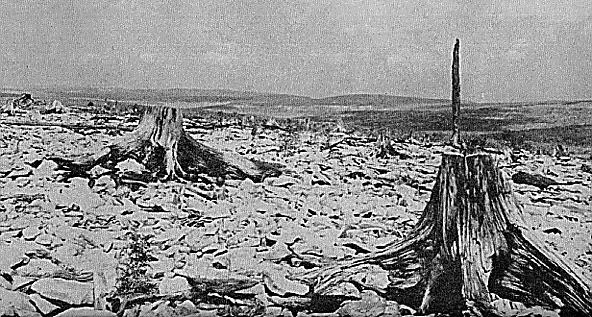
Like the barren surface of the moon, the crest of Cabin Mountain stretched out in a desolate field of rock. Botanist Harry Allard came across this stark image when he walked in the wastelands of Grant County’s spruce forests following an era of intensive logging and roaring forest fires. The life and death of West Virginia’s high altitude valleys is a story of a hidden boreal ecosystem, the transformative harvest of the forest, and its devastating aftermath, leaving little but the seeds for a hopeful rebirth.
The Golden Rule: A Tradition of Community Care
A Second American Revolution? The Great Railroad Strike of 1877
In July of 1877, a strike on the Baltimore and Ohio railroad threw the United States into a crisis that shook its very foundations. The outburst became the first nationwide general strike in US history, travelling across major and minor railroad lines and spreading into countless other industries. In the Appalachian Forest, battlegrounds erupted in Allegany, Morgan, and Mineral County in the mountains and woods along the B&O line. The uprising crossed divisions of race, gender, and status as the downtrodden rose up against an absolute power.
Elizabeth Dye Walker’s World of Transportation: Getting Around Before the Automobile
When Elizabeth Dye Walker lived in the Old Stone House of Mineral County in the beginning of the twentieth century, getting around employed a diversity of methods. It could mean a horseback ride, a horse-drawn buggy, or taking the Twin Mountain & Potomac Railroad. Where the railroad once ran, across the Northwestern Turnpike from the Stone House, now lies a trucking facility. Elizabeth Dye Walker’s childhood in the Stone House was colored by these various modes for motion, the resilient horse-drawn buggy and sled, a fruitless fruit-filled train, and a peculiar horseless carriage.
Paw Paw and its Apple Orchard Industry
By 1910 there were more than 150 orchards in Morgan and Hampshire counties. A 1919 census of orchards by the WV Department of Agriculture recorded eight orchards in Paw Paw, with a crop of 105,000 bushels. In 1940, the Consolidated Orchard Company constructed a modern packing plant with a capacity of 130,000 bushels, which grew to a capacity of 200,000+ bushels by 1963. On April 16, 1948 Consolidated Orchard hosted the dedication of the B&O Railroad “Paw Paw” Pullman car. B&O chose to honor “Paw Paw” because of the town’s importance as an apple producing center, and the prominence of Henry Miller, Jr as a producer, shipper, and apple authority.
The First Arthurdale Christmas
First Lady Eleanor Roosevelt was deeply involved in all aspects of the Arthurdale homestead. She watched over the process as the federal government began turning the Arthurdale farm into a community for the long-term unemployed. Mrs. Roosevelt visited Arthurdale in December of 1934 and announced the plans for the homesteaders' first Christmas to the newspapers. Their first Christmas allowed the homesteaders to work together for a joyous occasion.
Loss of Bomber No. 5 and Its Labor History
Following the Battle of Blair Mountain, a U.S. Army Air Service Martin NBS-MB-1*—Bomber No. 5—crashed near Drennen, Nicholas County, West Virginia. Its role in suppression of the largest armed uprising since the Civil War was thereby etched into the hills of West Virginia and into the labor history of our Nation.


